
PustakMaitri
A bookshop's counter, stock, buying, accounts and customers in one system, with an online shop in Marathi and English, savings groups, offers and a team that can see only what it should.
What it is
PustakMaitri runs a bookshop from one place. The counter scans a book, attaches a customer, takes payment and prints the bill. Behind it sit the catalogue with every title's prices and shelf stock, the vendors and purchase bills that fill the shelves, and the ledgers that say who owes the shop and whom the shop owes.
Alongside the till it handles the things a bookshop actually does: Bhishi savings accounts and groups that customers spend as book credit, gift cards, coupons, lending books to read and return, pre-orders and a waiting list for books the shop does not have yet, and special publications such as a Diwali Ank run as their own small project.
Readers get an online shop in Marathi and English with offers, events, author pages and a way to ask for a book, and the owner gets reports and an AI assistant that answers questions from the shop's own stock and sales. Every screen has a help page in both languages inside the app.
- 61screens for running the shop
- 2languages: Marathi and English, in the app and the handbook
- 8built-in roles with their own permissions
- 3parts: counter, back office and online shop
What was going wrong
Who it was built for
PustakMaitri was built for an independent bookshop that sells in Marathi and English, over the counter and online: a large catalogue, vendors who supply in lots, regular customers on credit, Bhishi savings groups, special publications such as a Diwali Ank, and a small team of counter staff, a stock keeper and an accountant.
The situation
In a bookshop the same title is bought in lots at different prices, sold at the counter and online, lent, booked ahead and written off, and the money is split between cash, UPI, credit and savings schemes. When each of those lives in its own register or sheet, the shelf stops matching the books, dues are forgotten and nobody can say what a title really earned. These are the problems the system is built around.
How we solved it
5 problems, and what the system does about each.
The shelf never matches the books
The problem
Copies come in at different prices, leave through bills, returns and write-offs, and a count on the shelf disagrees with the register.
How we solved it
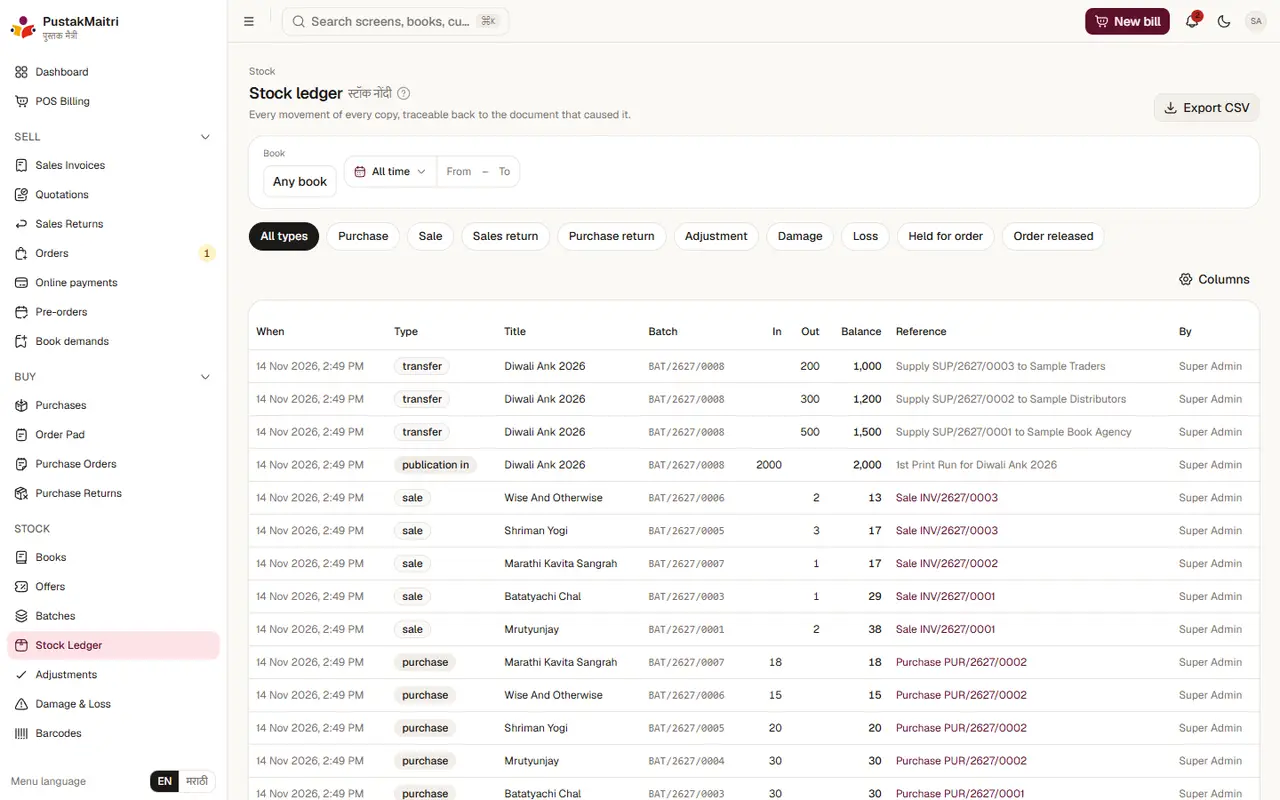
Each purchase lot is its own batch with the price paid, copies leave in a set order, and the stock ledger traces every movement to the bill or document that caused it. A shelf count is reconciled as a stock adjustment that a manager approves, and damage and loss are recorded with a reason.
Money owed gets forgotten
The problem
Customers buy on credit and vendors are paid in parts, and nobody can say who owes what, or for how long.
How we solved it
Money to collect lists everyone who owes the shop, longest-owed first, with a WhatsApp reminder on each. Vendors have terms and a balance, and customer and vendor ledgers only ever add rows, so a mistake is corrected by a new entry and the history stays.
Marathi titles are slow to find and print badly
The problem
Typing a Marathi title at a busy counter is slow, and printed Devanagari comes out with broken letters.
How we solved it
At the counter a Marathi title can be typed in English letters and still be found, and the catalogue holds titles, authors and descriptions in both languages. Bills, catalogues and statements are drawn with a Devanagari-aware PDF engine so the letters join correctly.
The shop only sells to people who walk in
The problem
Readers cannot see what is in stock or on offer, and a book the shop does not have is simply a lost sale.
How we solved it
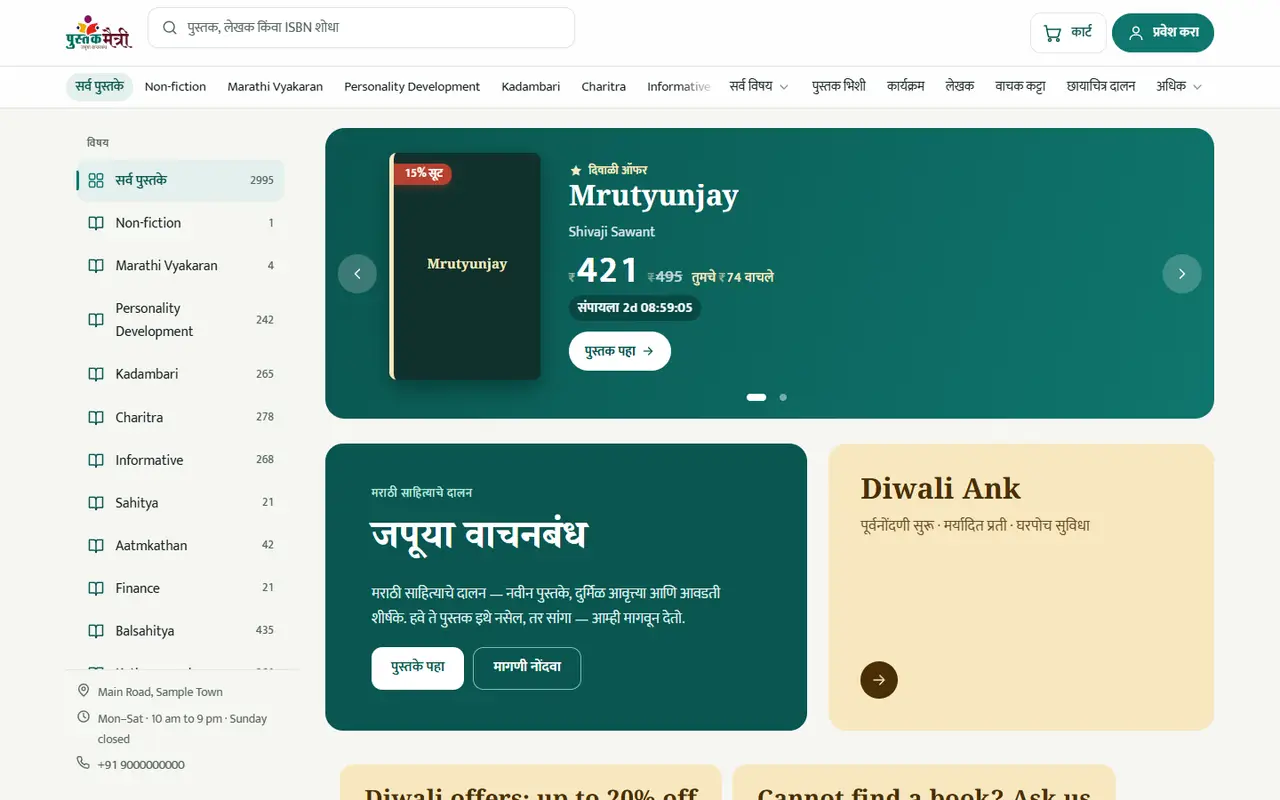
An online shop in Marathi and English shows the catalogue, offers with a countdown, events and author pages. Readers can order, ask for a book the shop does not stock, which lands on a waiting list, and ask to join a Bhishi group.
Bhishi savings and special issues are tracked on the side
The problem
Monthly savings groups and a Diwali Ank have their own money, turns and costs, and they get mixed up with the shop's books.
How we solved it
Bhishi accounts and groups keep each member's instalments and the fixed turn order, and payouts are book credit that is spent at the till, never cash. A publication is its own project, with advertising, printing costs, copies and profit tracked apart from the regular book stock.
Everything it does, by area
72 features in 11 areas, taken from what the system actually does today.
Counter billing
The screen the queue stands in front of.
Scan or search
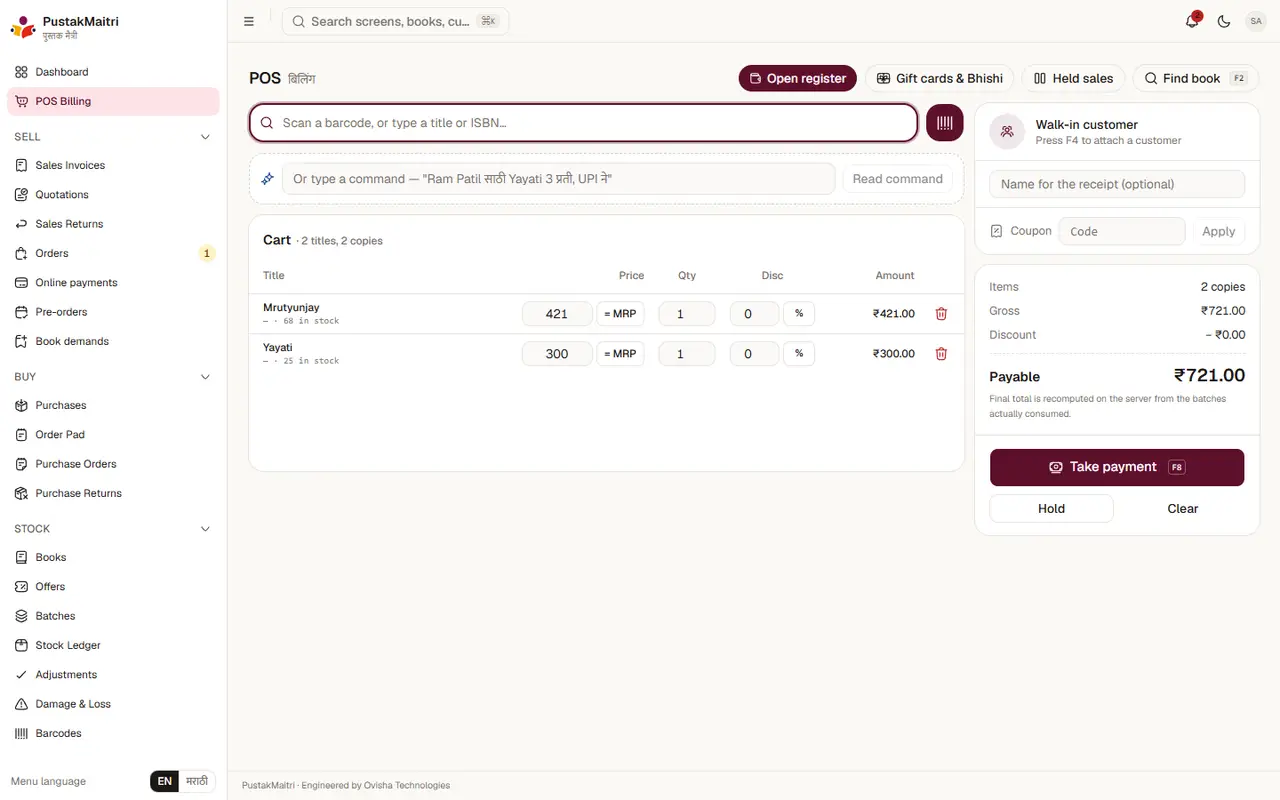
Scan a barcode with a handheld scanner or the phone's camera, or search by title, author or ISBN. A Marathi title can be typed in English letters.
Keyboard shortcuts
F2 searches for a book, F4 attaches a customer, F8 opens payment and Esc closes a dialog, so a queue can be served without the mouse.
Hold a bill
Park a bill while the customer fetches another book and come back to it. A bill in progress survives an accidental page reload.
Price changes and discounts
Change the selling price or give a discount on a line, within the limits each role is allowed.
Customers, coupons, gift cards and Bhishi
Attach a customer, apply a coupon code, take payment from a gift card or spend a Bhishi balance at the same till.
Counter shorthand
With AI switched on, type a line such as a customer, a title, copies and payment mode in Marathi or English. The system shows what it understood and nothing is billed until the cashier confirms.
Bills, quotations and returns
Every bill is kept with what was paid and what is still owed. Quotations carry an expiry date for institutional buyers, and returns are recorded by condition with a credit to the account or a cash refund.
Cash register
Open the drawer at the start of the day and close it with the counted cash, with the difference between expected and counted shown.
Works on a phone
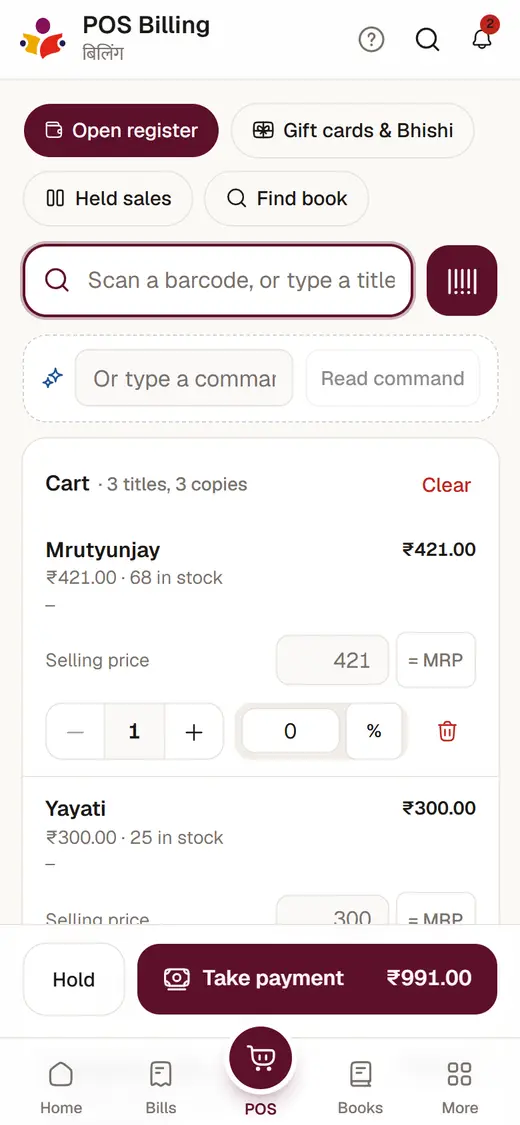
The same screen stacks into one column on a phone, with Hold and Take payment in a bar at the bottom.
Catalogue and stock
Every title, its prices and exactly how many copies are on the shelf.
Books
Titles with author, publisher, category, language, ISBN, MRP, selling price, average cost and stock, in Marathi and English, with a filter for in stock, low and out.
Import from a spreadsheet
Add many books and their opening stock from one spreadsheet.
Master data
Shared lists of authors, publishers, categories and languages that every book, batch and bill is built from.
Batches
Each purchase lot is its own batch. Its purchase price is history and never changes, and the oldest lot leaves the shelf first by default.
Stock ledger
Every copy's movement, from purchase in to sale out, traced back to the document that caused it.
Adjustments, damage and loss
Reconcile the shelf with the system and approve to update stock, and record copies lost to water damage, theft, printing defects or mishandling.
Barcode labels
Print label sheets with title, price and barcode for the shelves.
Catalogue sheet
Build a PDF of chosen titles with the details you pick, to send to a customer.
Media library
Every uploaded image in one place, so a cover is reused instead of uploaded twice.
Buying
From deciding what to order to the books arriving on the shelf.
Purchases
Enter the vendor's bill and the books become sellable. Opening stock can be entered for a shop that is starting out.
Order pad
A running list of what the shop intends to buy, split across vendors later.
Purchase orders
A request to one named vendor, split off the order pad. No stock moves and no money is spent until the books arrive.
Purchase returns
Send stock back to a vendor and receive credit at the price they charged.
Vendors
Suppliers with payment terms and what the shop currently owes each one, with a ledger per vendor.
Accounts and cash
Where the money is, who owes it and what it is for.
Money in
Every rupee that came in and went out over a period, from bills, customers, distributors and advertisers, with what was handed back.
Money to collect
Everyone who owes the shop, longest-owed first, with a WhatsApp reminder on each.
Receipts and payments
Money coming in from customers against what they owe, and money going out to vendors against what the shop owes.
Expenses
Overheads and publication costs recorded under categories, with an optional approval threshold.
Ledgers
A ledger for every customer and vendor. Entries are only ever added, and a balance comes from the latest row.
Payroll
A month's salary is worked out from attendance, closed once the month is over, then paid and posted to expenses.
Customers, savings and offers
Keeping readers coming back.
Customers
Contact details, customer type (retail, wholesale, institution, member or distributor), credit limit and ledger.
Bhishi accounts
A customer saves a fixed amount each month and spends the balance on books.
Bhishi groups
A fixed set of members pay a monthly instalment into one pot and each takes the whole pot as book credit on their turn. The turn order is fixed at the start and payouts are book credit, never cash.
Gift cards and coupons
Prepaid store credit that can be issued with or without a customer, and discount codes that apply to the whole cart at the counter.
Lending
Books lent to read and return. The copy is tracked as on loan, not sold, until it comes back.
Offers
Limited-time offers on one book or a whole shelf, listed as running, coming up and ended, with a warning when one is about to end.
Offer graphics
A ready-to-post picture or short video of one book or several, in Marathi, with the cover, the offer price and the shop's name, to share to WhatsApp or Instagram.
Reviews
Readers' stars and words wait for approval, and a link can be sent after a bill to ask for them.
Orders, pre-orders and demands
Books people want and do not take away today.
Orders
Books a customer has asked for and not yet taken away, from the website or the counter, with a status from awaiting payment to completed.
Online payments
What customers paid through Razorpay on the website, and every message Razorpay sent the shop about it.
Pre-orders
Bookings taken before a title reached the shelf, fulfilled by priority and then by who booked first.
Book demands
A waiting list for books customers want that are not in stock right now.
Online shop
The storefront readers open on their phones, in Marathi and English.
Browse and search
Search by title, author or ISBN, browse categories, and open a book page with price, discount, stock and reviews.
Offers with a countdown
Live offers show how long they have left.
Cart, checkout and accounts
Readers register, order and track their orders from their own account.
Bhishi on the website
Readers see how a Bhishi group works and send a request to join, which waits for the shop to approve it.
Request a book
Readers ask for a title the shop does not stock, and it lands on the shop's demands list.
Events, authors and gallery
Book launches and author visits with RSVP, a public page for each author with their books, and a gallery of shop photos and testimonials.
Edit the storefront
Change the homepage hero, banners, pages such as About and Contact, and the navigation menu from the admin.
Installs like an app
The shop installs to a phone's home screen from the browser.
Visitor counts without tracking
See who opened the shop, on what device and from where, counted on the shop's own server with no IP address or name kept.
Publications and events
For a shop that also publishes.
Publications
Run a Diwali Ank or special issue as its own project, with advertising, printing costs, copies and profit tracked apart from the regular book stock.
Author desk
Authors are invited to a desk of their own, and each author with a public page can share it.
Events
Create events as drafts, publish them to the storefront and cancel them if plans change.
Team, control and communication
Who may do what, and a record of what they did.
Roles and access
Eight built-in roles (Super Admin, Admin, Manager, Accountant, Sales Staff, Inventory Staff, Publication Staff and Viewer), each a set of ticks that an Admin can change.
Users
Staff accounts with the permissions their role carries, and a forced password change on first sign-in on a real install.
Attendance
Staff check in and out each day, and supervisors mark the team by day or month and print the register.
Audit log
A read-only record of who changed books, customers and vendors, and when.
Workflow
An expense approval threshold, an inbox of everything waiting on you, and IF-THIS-THEN-THAT automation rules that raise reorder suggestions or flag records.
Communication
Staff announcements that land in the team's notification bell, email broadcasts to customers and push notifications.
Message templates
The words of every automatic email, WhatsApp message and alert, in English and Marathi, with a preview and an optional picture or video.
Modules
Turn off the parts of the system this shop does not use.
Reports and AI
Answers from the same ledgers the screens read.
Sales
Daily sales, sales by book, by customer and returns, with a date range, a chart and a CSV export.
Purchases
Purchases by vendor and by book, and purchase returns.
Stock
Current stock, low stock, dead stock and batch-wise stock.
Finance
Profit and loss, customer outstanding, vendor outstanding and a GST summary.
Dashboard
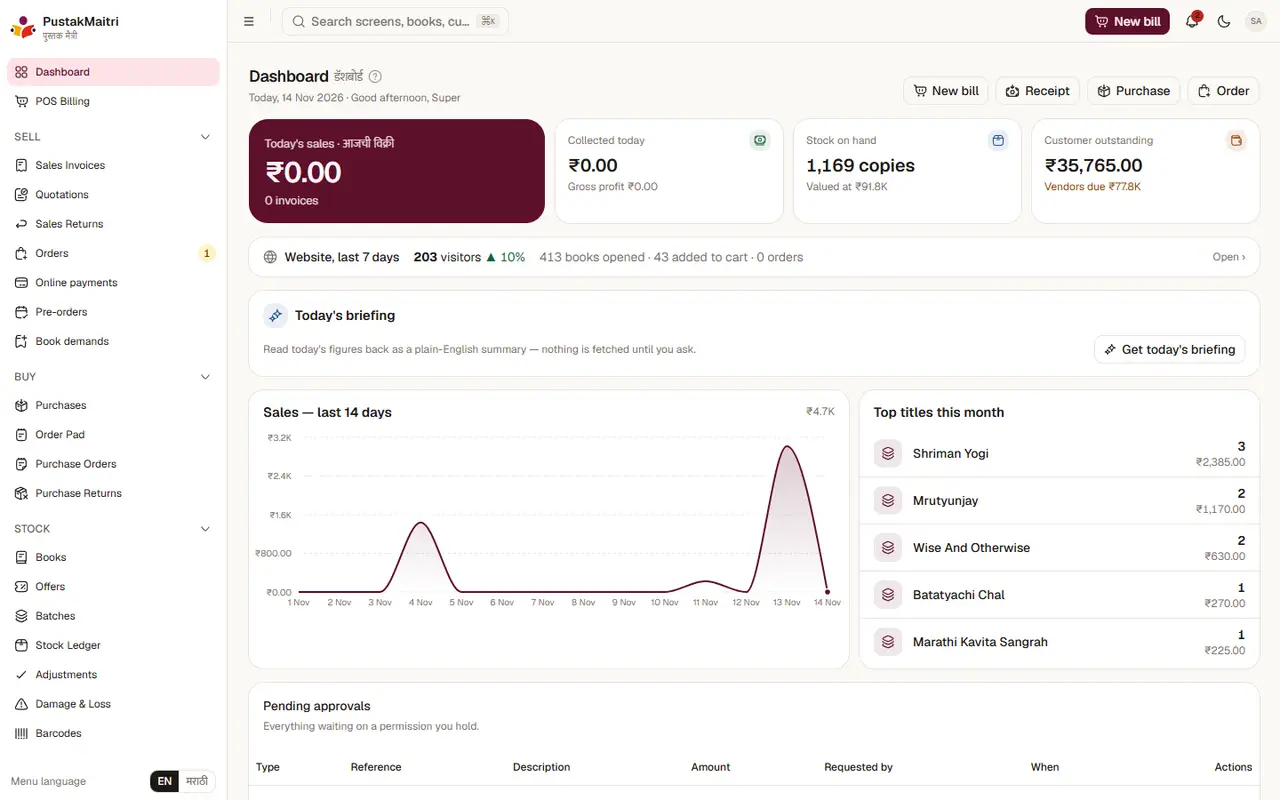
Today's takings, copies and value on the shelf, what is owed, the last fourteen days' sales, top titles and what needs attention.
AI assistant
Ask questions about stock and sales, draft descriptions, get title suggestions and cover tagging, and see reorder insights. Every AI call is logged with its cost.
Platform and safety
How it is delivered and looked after.
Marathi and English
Switch the whole interface between Marathi and English, and print bills, catalogues and statements with Devanagari shaped correctly.
A handbook inside the app
Each screen has an info icon and a help page in both languages, with pictures made from a sample shop.
Backups
Hot, consistent snapshots of the shop's databases, with the uploaded pictures alongside.
Maintenance tools
A curated list of maintenance commands run from the browser, and a reset that clears chosen parts of the data.
Light and dark
A theme toggle and layouts that work on a phone, a tablet and a desktop.
See it working
The screens that matter most, from the running system with sample data. Tap a picture to open it full size.
On a computer
On a phone
What it is built with
Server
- Laravel 13 (PHP 8.3+)
- Laravel Sanctum sign-in
- SQLite database
- spatie/laravel-permission for roles
- spatie/laravel-activitylog for the audit log
- mPDF for Devanagari-correct PDFs
- Hot SQLite backups
Web app
- React 19 and TypeScript
- Vite and Tailwind CSS v4
- base-ui components
- React Router and TanStack Query
- Recharts for reports
- Installable PWA with web push
Integrations
- Razorpay for online payments
- WhatsApp links for bills, reminders and offers
- Email for confirmations and broadcasts
- AI through OpenRouter (optional)
- Camera barcode scanning in the browser
Who uses it day to day
Bookshop owners
See takings, stock and money owed at a glance, and run offers and Bhishi groups without spreadsheets.
Counter staff
Bill quickly by scanning or searching, in Marathi or English, and take payment in the ways customers actually pay.
Stock keepers and buyers
Enter purchases, keep batches and stock honest, and raise purchase orders and returns.
Accountants
Receipts, payments, expenses, ledgers and finance reports from the same data.
Publishers and authors
Run a special issue as its own project, and give authors a page of their own.
Readers
Browse, order and ask for books on their own phone, and join a Bhishi group.
Want to see it yourself?
Want a system like this for your business?
A free 30-minute call with the founders. You keep the written proposal either way.